
Choosing between a dry type vs oil type transformer is one of the first big decisions on any power distribution project. Get it right, and the unit runs quietly for years. Get it wrong, and you may face fire-safety redesigns, cooling problems or maintenance costs nobody budgeted for. In Saudi Arabia, where summer heat, fine dust and tight indoor plant rooms are part of daily life, the choice matters even more.
So this guide compares both technologies side by side. It also covers construction, cooling, fire considerations, maintenance and lifecycle cost. It also explains how local site conditions affect the decision, so engineers and procurement teams can shortlist the right option with confidence.
Key Takeaways
- Dry-type transformers use air and solid insulation, such as cast resin, so there is no liquid to leak or catch fire. As a result, this makes them a common choice for indoor and occupied buildings.
- Oil-type (liquid-immersed) transformers, on the other hand, use insulating liquid for cooling and insulation. They are also widely used outdoors and at higher power ratings.
- However, purchase price is only part of the picture. In addition, civil works, fire protection, oil handling and maintenance all shape the real lifecycle cost.
- Saudi ambient temperatures can exceed the reference conditions used in many standard ratings, so derating or a special design may be needed for either type.
- Finally, the final choice should be checked against your load profile, installation location and the project specification, not a general rule.
Table of Contents
What Is a Dry-Type Transformer?
A dry-type transformer is a transformer whose core and windings are not immersed in liquid. Instead, the windings are insulated with solid materials and cooled by surrounding air. Natural air circulation does most of the work, although some units also use fans to increase capacity.
There are two common designs:
- Cast resin transformers: The windings are fully encapsulated in epoxy resin. As a result, they are well protected against moisture and dust.
- Vacuum pressure impregnated (VPI) transformers: The windings are impregnated with varnish or resin under vacuum and pressure, and then cured.
In general, international requirements for this equipment are set out in IEC 60076-11, the standard for dry-type transformers. It also defines environmental (E), climatic (C) and fire behaviour (F) classes. For example, Magnetic’s cast resin transformers are listed with Climatic C2, Environmental E2 and Fire F1 classes.
What Is an Oil-Type Transformer?
An oil-type transformer, often called a liquid-immersed or oil-filled transformer, places the core and windings inside a sealed tank of insulating liquid. Mineral oil is the traditional choice. However, natural and synthetic ester fluids are also used where better fire performance or biodegradability is needed.
The liquid does two jobs. First, it insulates the live parts. Then, it carries heat away from the windings to radiators or cooling fins on the tank. Also, common cooling methods include ONAN (oil natural, air natural) and ONAF (oil natural, air forced), where fans boost the radiator airflow.
Because liquid transfers heat well, oil-type units are a familiar sight in outdoor substations, utility networks and large industrial plants. In addition, their loading behaviour is described in IEC 60076-7, the loading guide for oil-immersed power transformers.
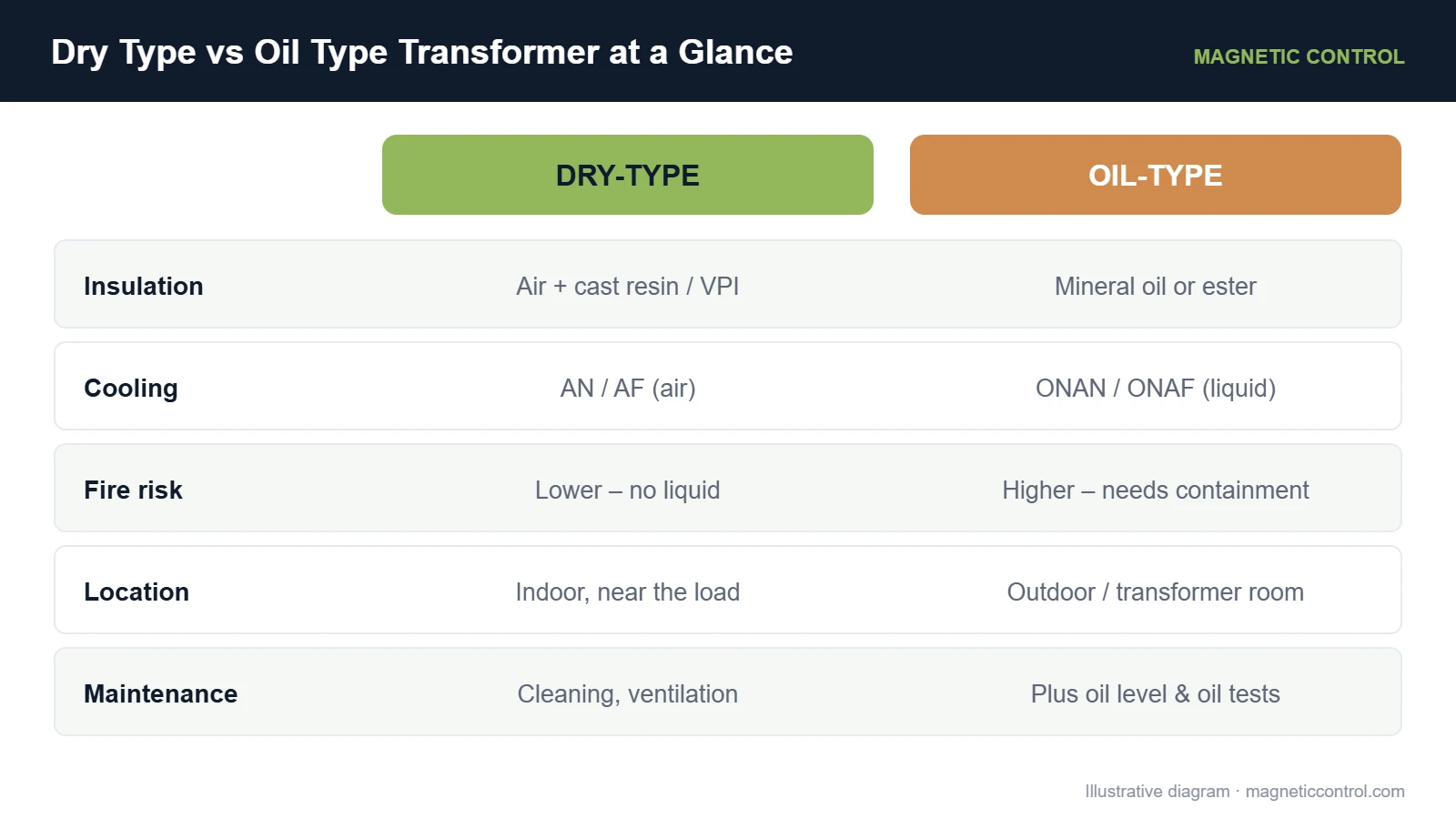
Dry Type vs Oil Type Transformer: Key Differences
When engineers compare a dry type vs oil type transformer, they find that both technologies convert voltage in the same basic way. However, the real differences come from insulation and cooling. These, in turn, affect where you can install the unit and how you maintain it.
Construction and Insulation
Dry-type units rely on solid insulation and air, whereas oil-type units rely on liquid insulation inside a tank, often with a conservator or a sealed design to handle oil expansion. As a result, an oil-type transformer needs gaskets, valves and level indicators that a dry-type unit simply does not have.
Cooling
Oil is a more effective cooling medium than air. So for the same rating, an oil-type unit is often more compact in its active parts. In contrast, dry-type units depend on good room ventilation. So if the plant room is hot or poorly ventilated, the transformer may need fans or a larger design.
Fire Considerations
This is often the deciding factor. A dry-type transformer contains no insulating liquid, so there is no pool of oil to feed a fire. For example, cast resin designs with an F1 fire class are made to limit flammability and smoke. Oil-type units, by contrast, usually need fire separation, oil containment (bunds or pits) and suitable clearances, especially indoors. Overall, the exact requirements depend on the local authority, the insurer and the project specification.
Installation Location
Dry-type transformers are well suited to indoor installation close to the load. For example, that includes basements, plant rooms, hospitals, malls and high-rise buildings. Oil-type transformers, however, are usually placed outdoors or in dedicated, fire-rated transformer rooms.
Maintenance
Neither type is truly maintenance-free. A dry-type unit still needs cleaning, ventilation checks and connection inspections. An oil-type unit, by contrast, needs those checks plus oil level checks, leak inspections and periodic oil testing. For a full routine, see our transformer maintenance checklist.
Dry Type vs Oil Type Transformer Comparison Table
| Factor | Dry-Type Transformer | Oil-Type Transformer |
|---|---|---|
| Insulation | Air plus solid insulation (cast resin or VPI) | Insulating liquid (mineral oil or ester) |
| Cooling | AN (natural air) or AF (forced air) | ONAN, ONAF and other liquid-based methods |
| Fire risk | Lower; no flammable liquid | Higher, so oil needs containment and fire measures |
| Typical location | Indoor, close to the load | Outdoor or dedicated transformer rooms |
| Environmental risk | No oil leaks | Possible leaks; bunding usually required |
| Routine maintenance | Cleaning, ventilation, connection checks | Same checks, as well as oil level, leaks and oil testing |
| Overload behaviour | More sensitive to sustained overload and high ambient temperature | Liquid thermal mass helps absorb short overloads |
| Initial cost | Often higher per kVA, especially at large ratings | Often lower per kVA, especially at large ratings |
Note: The table shows general trends. In practice, actual performance and cost depend on the design, rating, manufacturer and project.
Dry Type Transformer Advantages and Limitations
Many of the dry type transformer advantages come from the absence of oil. Here is a balanced view.
Advantages
- Reduced fire risk, which simplifies indoor installation.
- No oil leaks, so there is no need for oil pits or oil handling.
- Can be installed close to the load, which shortens low-voltage cable runs.
- Simpler routine maintenance, since there is no oil sampling.
- Well suited to buildings where people work or gather, such as offices and hospitals.
Limitations
- Needs a clean, well-ventilated room, because dust build-up can block cooling paths.
- More sensitive to high ambient temperatures and sustained overloads.
- Can be larger and costlier than an oil-type unit at high ratings.
- Needs an enclosure with a suitable IP rating when installed in harsh or outdoor locations.
Oil-Type Transformer Advantages and Limitations
Advantages
- Efficient cooling, which suits high power ratings.
- Good tolerance of short overloads thanks to the oil’s thermal mass.
- Robust for outdoor installation.
- Oil analysis can also reveal developing faults early.
Limitations
- Flammable liquid means extra fire protection and containment, too.
- Risk of leaks and environmental contamination.
- More maintenance tasks, including oil testing.
- Usually not suitable for installation inside occupied buildings without special measures.
Engineering Insight — Transformer Selection
“The appropriate transformer depends on the electrical load, installation environment, cooling requirements and applicable project specifications.”
Original editorial insight from the Magnetic Control content team.
Dry Type vs Oil Type Transformer: Purchase vs Lifecycle Cost
In any dry type vs oil type transformer comparison, it is tempting to compare price tags and stop there. However, the purchase price is only one line in the budget. A fair comparison should include:
- Civil and building works: oil pits, fire walls and transformer rooms add cost for oil-type units.
- Fire protection: similarly, detection and suppression systems may be needed around oil-filled equipment.
- Cabling: a dry-type unit placed near the load can shorten expensive low-voltage cable runs.
- Losses: no-load and load losses affect energy cost over the transformer’s whole service life.
- Maintenance: finally, oil testing, filtration and leak repairs add recurring cost.
So a transformer that is cheaper to buy is not always cheaper to own. Therefore, ask suppliers for loss figures and compare them over the expected operating hours.
Saudi Arabia Site Conditions That Affect Selection
Local conditions in the Kingdom put extra stress on transformers of both types. Therefore, they should shape your dry type vs oil type transformer decision from day one.
High Ambient Temperature
Standard ratings are often based on reference conditions, such as a maximum ambient temperature of around 40 °C. However, summer temperatures in many parts of KSA can go beyond that. As a result, a transformer may need derating, extra cooling or a design for a higher ambient temperature. So always state the real site ambient temperature in your enquiry.
Dust and Sand
Fine dust can settle on dry-type windings and block cooling ducts. Therefore, in dusty areas, specify a suitable enclosure, filtered ventilation and a regular cleaning plan. Oil-type units are sealed, but dust can still clog radiators and reduce cooling.
Ventilation in Plant Rooms
Indoor dry-type units release heat into the room. Consequently, if the room cannot remove that heat, the transformer runs hotter and ages faster. So plant room ventilation or air conditioning must be designed for the transformer’s losses.
Dry Type vs Oil Type Transformer by Application
The table below shows how the dry type vs oil type transformer choice often plays out in common applications. However, treat it as a starting point, not a rule.
| Application | Common Choice | Why |
|---|---|---|
| Commercial buildings and malls | Dry-type | Indoor installation and reduced fire risk |
| Hospitals and public buildings | Dry-type | Occupied spaces and strict fire requirements |
| Data centers | Dry-type (often) | Indoor placement close to IT loads |
| Industrial plants (indoor MCC rooms) | Dry-type | Close to process loads, no oil handling |
| Outdoor substations and utilities | Oil-type | High ratings and outdoor duty |
| Large industrial feeders | Either | Depends on rating, location and fire strategy |
For harmonic-rich loads, such as variable speed drives and IT equipment, also consider K-rated transformers designed for non-linear loads.
Factors Engineers Should Evaluate Before Selecting
- Load and rating: confirm kVA, voltage ratio and future growth. Our guide on how to calculate transformer kVA explains the method.
- Installation location: for example, indoor, outdoor, basement or rooftop.
- Ambient temperature and altitude: use real site data, not catalogue defaults.
- Fire and safety requirements: check the project specification and the authority having jurisdiction.
- Enclosure and IP rating: match it to dust, humidity and exposure.
- Losses and efficiency: compare total cost of ownership, not just price.
- Maintenance capability: consider what your team can support on site.
- Standards and specifications: confirm which IEC, IEEE or utility requirements apply to your project.
Important: Requirements differ between projects. Utility, consultant and owner specifications may set extra conditions, so always confirm which rules apply before you finalise equipment.
How Magnetic Control Can Help
Magnetic designs and manufactures low-voltage dry-type transformers at its factory in Al Kharj Industrial City. The range also includes cast resin, isolation, control, K-rated and auto transformers. The team can review your load, site conditions and enclosure needs, and then help you select a suitable dry-type unit. In addition, you can browse the full product range or speak with the sales engineers directly.
Choosing the Right Transformer for Your Project in Saudi Arabia?
The right transformer depends on your load requirements, installation environment and operating conditions. So contact Magnetic Control to discuss your project and explore a suitable transformer solution.
Frequently Asked Questions
What is the main difference between a dry-type and an oil-type transformer?
The main difference is the insulation and cooling medium. A dry-type transformer uses air and solid insulation, while an oil-type transformer uses insulating liquid inside a sealed tank. As a result, this affects fire risk, installation location and maintenance.
Which transformer is suitable for indoor installation?
Dry-type transformers are usually preferred indoors because they contain no flammable liquid. Oil-type units can be used indoors only with suitable fire separation, containment and approval under the project rules.
How do environmental conditions in Saudi Arabia affect transformer selection?
High ambient temperatures may require derating or a design for higher ambient conditions. Similarly, dust and sand call for suitable enclosures, filtered ventilation and regular cleaning. So always give the supplier the real site conditions.
Which factors influence transformer lifecycle cost?
Lifecycle cost includes the purchase price, energy losses, civil and fire protection works, cabling, maintenance and expected service life. Therefore, a cheaper unit with higher losses can cost more over time.
Are dry-type transformers maintenance-free?
No. Dry-type transformers need less maintenance than oil-type units, but they still need regular cleaning, ventilation checks and connection inspections according to the manufacturer’s instructions.
Conclusion
The dry type vs oil type transformer decision comes down to location, safety and total cost of ownership. Dry-type units suit indoor and occupied spaces where fire risk and oil handling are concerns. Meanwhile, oil-type units suit outdoor and high-rating duties where their cooling efficiency pays off. In Saudi Arabia, plan for heat, dust and ventilation from the start, whichever type you choose. If your project needs an indoor low-voltage solution, talk to Magnetic’s team about a dry-type transformer matched to your site.