
A clear transformer maintenance checklist is one of the simplest ways to protect expensive electrical equipment. Transformers often run for years without much attention, so small problems can grow quietly. For example, a blocked vent, a loose connection or a failing fan rarely causes trouble on day one. Over time, however, it can lead to overheating, insulation damage and unplanned shutdowns.
In Saudi Arabia, heat and dust make regular inspection even more important. This guide explains what to check, how often to check it, and when to call a qualified specialist. It also includes a practical checklist your team can adapt for its own sites.
Safety first: Inspections, testing and any work on transformers must follow the manufacturer’s instructions, applicable standards and your site’s approved electrical safety procedures, including isolation and lock-out/tag-out. Never open enclosures, touch connections or carry out tests on energised equipment unless you are qualified and authorised to do so under those procedures.
Key Takeaways
- Regular maintenance helps detect overheating, loose connections and insulation problems before they cause a failure.
- Routine visual checks can be done from outside the enclosure, while hands-on work needs de-energised equipment and qualified staff.
- In KSA, dust build-up and high ambient temperatures are major threats, so ventilation and cleaning deserve extra attention.
- Dry-type and oil-type transformers share many checks, but oil-type units also need oil level, leak and oil condition checks.
- Inspection intervals should follow the manufacturer’s guidance and the equipment’s criticality, not a one-size-fits-all schedule.
- Finally, good records turn individual inspections into trend data that reveals slow deterioration.
Table of Contents
Why Transformer Maintenance Matters
A transformer is often the single point that feeds an entire building or production line. So when it fails, everything downstream stops. Therefore, planned maintenance aims to prevent that by finding problems early.
Heat is the main enemy of transformer insulation. When a transformer runs hotter than its design limits, its insulation ages faster. In addition, dust, poor ventilation, overloads and harmonics can all raise operating temperature. As a result, a structured transformer maintenance checklist focuses heavily on cooling and temperature.
Regular maintenance also supports safety, warranty compliance and better budgeting. It is far easier to plan a short outage than to recover from an unexpected failure.
Preventive vs Corrective Maintenance
Preventive maintenance is planned work done at set intervals or based on condition. For example, this includes cleaning, inspections and scheduled testing. Corrective maintenance, on the other hand, happens after a fault or abnormal reading appears.
Ideally, a good programme leans on preventive work. It still leaves room for corrective action when inspections reveal a problem. Over time, recorded results also allow condition-based maintenance, where effort goes to the units that need it most.
Transformer Maintenance Checklist: Routine Visual Checks
Routine checks are quick observations made during normal site rounds. Also, they do not involve opening the enclosure or touching any part of the transformer. Look and listen for:
- Any alarm or trip indication on the temperature monitor or protection relay.
- The winding or oil temperature reading, compared with normal values for that load.
- Unusual humming, buzzing, crackling or vibration.
- Burning, hot or unusual odours near the unit.
- Blocked ventilation openings, such as items stored against the enclosure.
- Cooling fans running when they should be (if fitted).
- Signs of water ingress, pests or damage to the enclosure.
- On oil-type units, oil stains or drips around the tank, valves and gaskets.
If anything looks wrong, record it and report it. However, do not attempt a fix on live equipment.
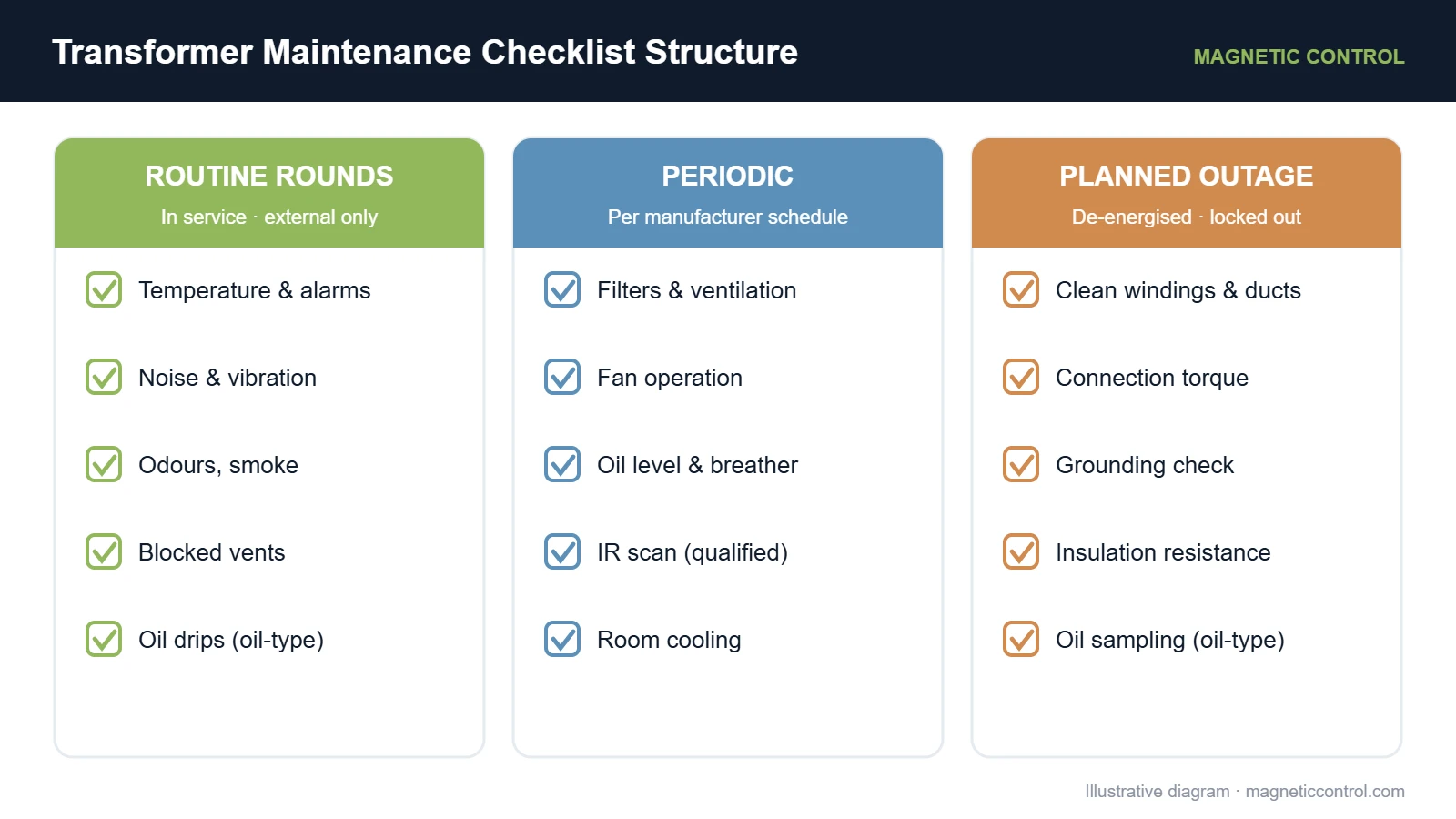
Periodic Inspection Schedules
How often should you inspect? There is no single answer. The right interval depends on the manufacturer’s recommendations, the load, the environment and how critical the transformer is. A unit feeding a hospital or data center deserves closer attention than a lightly loaded spare.
Guidance documents such as IEEE C57.94, the recommended practice for installation, operation and maintenance of dry-type transformers, can help shape your programme. However, the manufacturer’s manual for your specific unit should always come first.
Engineering Insight — Maintenance
“Maintenance planning should reflect equipment condition, operating conditions and manufacturer recommendations rather than relying on a universal inspection schedule.”
Original editorial insight from the Magnetic Control content team.
Cooling, Ventilation and Temperature Checks
Because heat drives insulation ageing, cooling checks are the heart of any transformer maintenance checklist.
- Ventilation openings: make sure louvres and filters are clean and unobstructed.
- Cooling fans: also confirm they start and stop at the correct temperature settings, and listen for worn bearings.
- Temperature indicators: record readings, and check that alarm and trip settings match the design values.
- Room conditions: check that plant room ventilation or air conditioning is working, especially during summer peaks.
In addition, infrared thermography can reveal hot spots at connections. It should be carried out by trained staff following approved procedures, for example through inspection windows rather than by opening live enclosures.
Connections, Grounding and Protective Devices
Loose or corroded connections create heat and can lead to failures. Similarly, a poor earth connection can create safety hazards. Therefore, these checks must be done only with the transformer de-energised, isolated, locked out and proven dead by qualified personnel.
- Inspect terminals and busbar connections for discolouration, corrosion or signs of overheating.
- Then check bolted connections against the manufacturer’s torque values.
- Inspect grounding conductors and bonding for damage and secure attachment.
- Test protective devices and temperature relays according to their own maintenance instructions.
- Never bypass or disable protective devices to keep a transformer in service.
Dry-Type Transformer Inspection Requirements
Dry-type transformers, such as cast resin transformers, have no oil to test. So their maintenance focuses on cleanliness, cooling and insulation.
- Clean dust from windings, cooling ducts and core surfaces during planned outages, using methods approved by the manufacturer.
- Look for cracks, tracking marks or discolouration on the resin or insulation surfaces.
- Also check that spacers, supports and clamping are secure.
- Carry out insulation resistance testing during outages, and compare results with earlier readings.
- Check enclosure seals and filters, especially in dusty areas.
To understand how this differs from oil-filled equipment, read our comparison of dry type vs oil type transformers.
Oil-Type Transformer Checks
Oil-type units also need all the general checks above. In addition, they need attention to the insulating oil itself.
- Oil level: check the gauge against the temperature-corrected normal level.
- Leaks: then inspect gaskets, valves, radiators and welds for drips or staining.
- Breather: where a silica gel breather is fitted, check the desiccant colour and replace it as needed.
- Oil condition: arrange sampling and laboratory testing, such as dielectric strength, moisture and dissolved gas analysis, at intervals set by the manufacturer or your asset owner.
- Pressure relief and protection devices: check indicators and alarms per the manufacturer’s instructions.
Oil sampling should only be done by trained personnel following the correct procedure.
Adapting Your Transformer Maintenance Checklist to Saudi Heat and Dust
However, Saudi sites present a tough mix of conditions. Summer temperatures in many regions can go beyond the reference ambient temperature used in many standard ratings. At the same time, fine dust and occasional sandstorms can clog filters and coat windings.
So for transformers in KSA, consider these extra steps:
- Increase the frequency of ventilation and filter checks during summer and after dust storms.
- Monitor temperature trends closely during peak load months.
- Also, make sure plant room cooling is sized for the transformer’s heat losses.
- Choose enclosures and IP ratings that suit the dust level at the site.
- Review loading too, since harmonic-rich loads may call for harmonic filters or K-rated designs.
Printable Transformer Maintenance Checklist
Many teams search for a transformer maintenance checklist PDF they can print and take on site. So you can print this page or copy the table below into your own maintenance system. The intervals shown are illustrative only. Therefore, replace them with the intervals in your manufacturer’s documentation and site procedures.
| Task | Applies To | Illustrative Frequency | Condition |
|---|---|---|---|
| Check temperature readings and alarms | All | Routine site rounds | In service, external only |
| Listen for abnormal noise or vibration | All | Routine site rounds | In service, external only |
| Check vents, filters and room ventilation | All | Monthly (more often in dusty seasons) | External only |
| Confirm cooling fans operate correctly | Units with fans | Monthly | Per manufacturer procedure |
| Inspect for oil leaks and check oil level | Oil-type | Monthly | External only |
| Check breather desiccant | Oil-type with breather | Monthly | External only |
| Infrared scan of connections | All | Periodic, as planned | Qualified staff, approved method |
| Clean windings and ducts | Dry-type | Planned outage | De-energised and locked out |
| Check connection tightness and grounding | All | Planned outage | De-energised and locked out |
| Insulation resistance test | All | Planned outage | Qualified staff, de-energised |
| Oil sampling and laboratory analysis | Oil-type | As set by manufacturer or asset owner | Qualified staff |
| Test protection and temperature relays | All | As set by device instructions | Qualified staff |
| Update maintenance log | All | After every inspection | — |
Inspection Records and Maintenance Logs
An inspection is only useful if someone records it. A simple log makes trends visible. For example, a winding temperature that creeps up a few degrees each summer may point to a ventilation problem long before an alarm trips.
Record at least the following for every visit:
- Date, time and inspector name.
- Transformer ID, location and load at the time of inspection.
- Ambient and transformer temperature readings.
- Test results, with the test method and instrument used.
- Defects found, actions taken and follow-up required.
Warning Signs That Need Qualified Assessment
However, some symptoms call for prompt attention from a qualified transformer specialist. These include:
- Temperature alarms or trips, or readings well above normal for the load.
- New or louder noise, crackling or arcing sounds.
- Burning smells, smoke or visible discolouration.
- Falling insulation resistance compared with previous results.
- Oil leaks, a sudden drop in oil level or abnormal oil test results.
- Repeated protection operations without a clear cause.
If you see any of these, follow your site’s emergency and isolation procedures and contact a qualified professional.
Need Help Planning Your Transformer Maintenance?
Use a structured maintenance plan to support equipment reliability and identify potential issues early. So contact Magnetic Control to discuss your transformer application and technical requirements.
Frequently Asked Questions
How often should a transformer be inspected?
There is no universal interval. Inspection frequency should follow the manufacturer’s recommendations, the transformer’s criticality and its operating environment. For example, sites with heavy dust or high loads usually need more frequent checks.
What should a transformer maintenance checklist include?
It should cover temperature readings, noise and vibration, ventilation and fans, enclosure condition, connections and grounding, insulation testing and, for oil-type units, oil level, leaks and oil condition. It should also include a record of every inspection.
Is there a transformer maintenance checklist PDF I can use?
Yes. You can print this page or copy the checklist table into your own system. Adjust the intervals to match your manufacturer’s documentation and site procedures before using it.
How does Saudi Arabia’s climate affect transformer maintenance?
High ambient temperatures raise operating temperature, while dust can block ventilation and coat windings. As a result, transformers in KSA often need more frequent cleaning, filter checks and temperature monitoring, especially in summer.
Can maintenance be done while the transformer is energised?
Only external visual checks and readings should be taken while a transformer is in service. In contrast, cleaning, connection checks and most testing require the unit to be de-energised, isolated and locked out by qualified personnel.
Do dry-type transformers need maintenance?
Yes. Dry-type transformers need less maintenance than oil-type units, but they still require regular cleaning, ventilation checks, connection inspections and insulation testing.
Conclusion
A practical transformer maintenance checklist helps you catch heat, dust and connection problems before they become failures. So focus on cooling and temperature, keep accurate records, and follow the manufacturer’s instructions and safety procedures at every step. In Saudi Arabia’s climate, step up ventilation and cleaning checks during the hottest and dustiest months. If you need advice on the right transformer for a demanding site, contact Magnetic’s technical team.