
Knowing how to calculate transformer kVA is a core skill for anyone who designs or buys electrical equipment. Choose a transformer that is too small, and it will overheat and age early. Choose one that is far too large, and you pay more for the unit while also carrying extra no-load losses. Fortunately, the basic maths is simple.
So this guide explains what kVA means and how it differs from kW. It also walks through single-phase and three-phase formulas, with worked examples and practical checks. Finally, it shows how to move from a calculated number to a sensible transformer rating for real projects in Saudi Arabia.
Key Takeaways
- Transformers are rated in kVA (apparent power) because their heating depends on current and voltage, not just on real power.
- Single-phase: kVA = V × I ÷ 1,000. Three-phase: kVA = √3 × VL-L × IL ÷ 1,000.
- When the load is given in kW, divide by the power factor: kVA = kW ÷ PF.
- Add allowance for future growth, motor starting and harmonics, then pick the next standard rating.
- High ambient temperatures in KSA can reduce a transformer’s usable capacity, so confirm ratings at site conditions.
- Finally, a qualified electrical engineer should verify the final rating against the real load profile and project standards.
Table of Contents
What Does kVA Mean?
kVA stands for kilovolt-ampere. It is a measure of apparent power, the product of voltage and current in a circuit. One kVA equals 1,000 volt-amperes.
Transformers are rated in kVA rather than kW for a simple reason. That is because their losses and heating depend on the current flowing through the windings and the voltage across the core. However, they do not depend on how much of that power the load actually turns into useful work. So a transformer “sees” the full apparent power, whatever the load’s power factor.
kW vs kVA: What Is the Difference?
The two terms are related but not the same:
- kW (kilowatt) is real power. It is the power that does useful work, such as turning a motor shaft or heating an element.
- kVA (kilovolt-ampere) is apparent power. It includes real power plus reactive power, which magnetic loads such as motors need to build their magnetic fields.
- kVAR (kilovolt-ampere reactive) is reactive power, the part that flows back and forth without doing net work.
Together, these three values form a “power triangle”: kVA² = kW² + kVAR². As a result, kVA is always equal to or greater than kW.
Understanding Power Factor
Power factor (PF) is the ratio of real power to apparent power:
Power Factor = kW ÷ kVA
A purely resistive load, such as a heater, has a power factor close to 1.0. In contrast, motors, welders and many other industrial loads have a lower power factor, often somewhere between 0.7 and 0.9. So the lower the power factor, the more kVA you need to deliver the same kW. That is why power factor plays such an important role when you calculate transformer kVA for industrial loads.
Measurements Needed to Calculate Transformer kVA
Before you start, gather these values and keep the units consistent:
- Voltage (V): phase-to-neutral voltage for single-phase loads, or line-to-line voltage for three-phase loads.
- Current (A): the load current in amperes. For three-phase systems, however, use the line current.
- Real power (kW) and power factor: if the load is given in kW, as it often is on equipment nameplates.
- Phase configuration: single-phase or three-phase.
- Frequency: Saudi Arabia’s grid operates at 60 Hz, so make sure equipment ratings match.
Low-voltage systems in KSA commonly use 400/230 V or 380/220 V, depending on the installation. Therefore, always confirm the actual voltage with the project specification or utility.
How to Calculate Transformer kVA for Single-Phase Loads
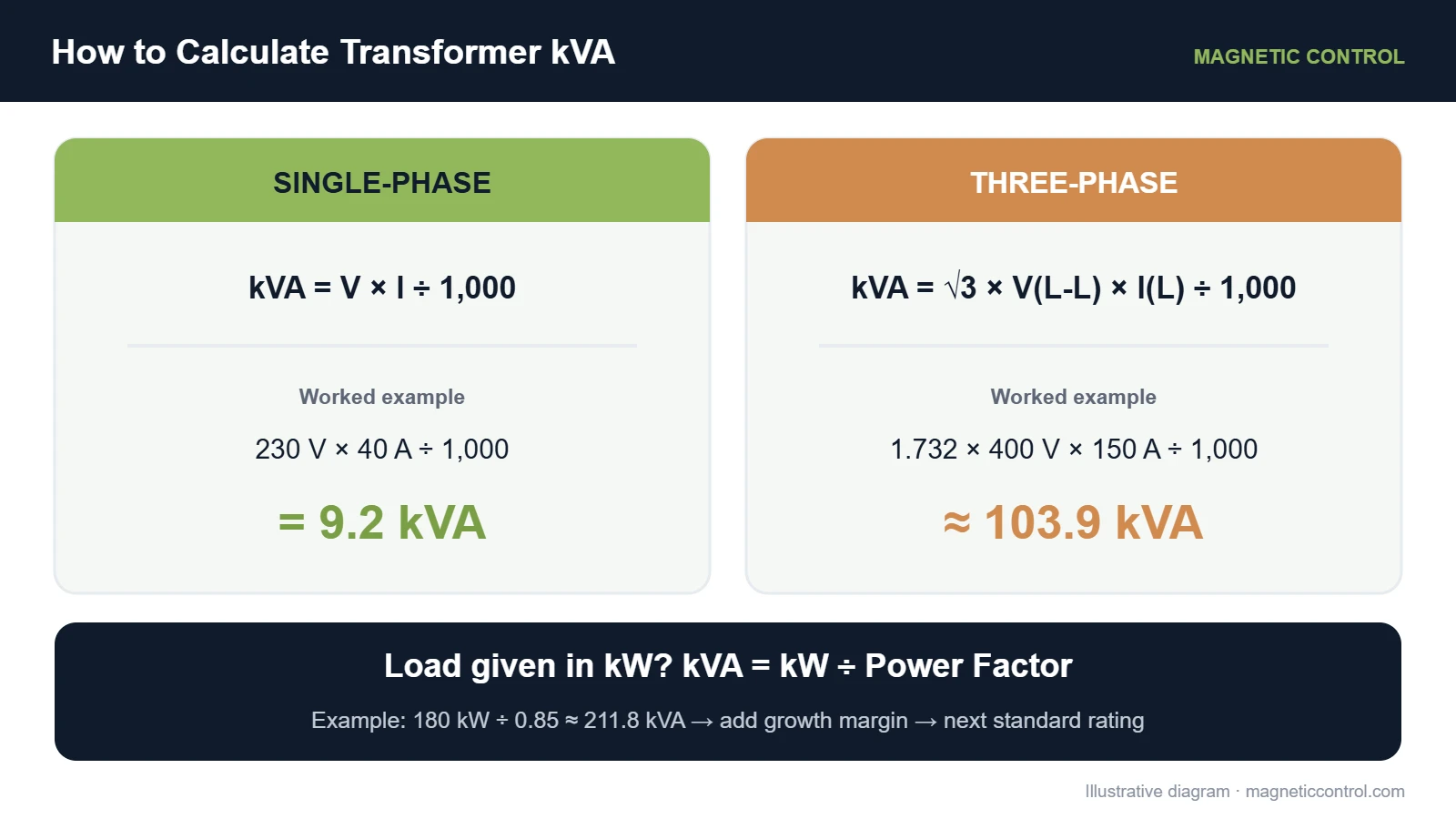
For a single-phase transformer, the formula is:
kVA = Voltage (V) × Current (A) ÷ 1,000
Worked Example 1: Calculate Transformer kVA for a Single-Phase Load
Assumptions: a single-phase load at 230 V that draws a continuous 40 A.
- kVA = 230 × 40 ÷ 1,000
- kVA = 9,200 ÷ 1,000
- Result: 9.2 kVA
Next, you would add any allowance for growth and select the next standard rating, such as 10 kVA. Even so, check whether 10 kVA still leaves enough margin for your load profile. If not, then move up to the next size.
How to Calculate Transformer kVA for Three-Phase Loads
For a balanced three-phase system, use line-to-line voltage and line current:
kVA = √3 × Line Voltage (V) × Line Current (A) ÷ 1,000
Here, √3 is approximately 1.732. In short, this factor accounts for the phase relationship between the three lines.
Worked Example 2: Calculate Transformer kVA From Three-Phase Current
Assumptions: a balanced three-phase load at 400 V line-to-line, drawing 150 A per line.
- kVA = 1.732 × 400 × 150 ÷ 1,000
- kVA = 103,920 ÷ 1,000
- Result: about 103.9 kVA
As a result, a 100 kVA transformer would be slightly overloaded here. So the next standard size in the manufacturer’s range, for example 125 kVA or 150 kVA, would be a more suitable starting point.
Worked Example 3: Calculate Transformer kVA From kW
Assumptions: a three-phase industrial load of 180 kW at a power factor of 0.85, with a 25% allowance for future expansion.
- kVA = kW ÷ PF = 180 ÷ 0.85
- Load kVA: about 211.8 kVA
- With 25% growth: 211.8 × 1.25 = about 264.7 kVA
- Suggested starting point: the next standard rating above 265 kVA, such as 300 kVA or 315 kVA, depending on the manufacturer’s range.
The 25% allowance here is an illustrative assumption. Instead, your own margin should come from the project’s growth plans and design standards.
How to Calculate Transformer kVA Rating From Load Requirements
However, real projects rarely have a single load. To find how to calculate transformer kVA rating for a whole facility, follow these steps:
- List every load: lighting, HVAC, motors, process equipment, IT loads and so on.
- Convert each load to kVA: use kW ÷ PF where needed.
- Apply demand or diversity factors: because not all loads run at full power at the same time.
- Add allowances: include motor starting, harmonics and future expansion.
- Correct for site conditions: check the effect of ambient temperature and installation.
- Select a standard rating: choose the next available size in the manufacturer’s range.
It also helps to work backwards. For instance, the full-load current of a three-phase transformer is I = kVA × 1,000 ÷ (√3 × V). For example, a 500 kVA transformer at 400 V has a full-load current of about 722 A. That figure helps when you size cables and protection.
Technical Note — Transformer Sizing
“Apparent power, expressed in kVA, is a key parameter in transformer selection; however, the final rating must also account for the actual load profile and applicable engineering requirements.”
Original editorial insight from the Magnetic Control content team.
How to Calculate Transformer kVA: Practical Checks
Continuous Loads
Loads that run for long periods, such as HVAC systems in a Saudi summer, keep the transformer hot for hours. So the rating must handle the sustained load, not just a short peak.
Motor Starting Currents
Motors can draw several times their full-load current when they start directly on line. This can cause voltage dips. If large motors start often, check the voltage drop during starting, or consider soft starters, drives or a larger transformer.
Harmonics
Equipment such as variable speed drives, UPS systems, LED lighting and IT loads creates harmonic currents. These raise transformer losses and temperature. Therefore, for such loads, consider K-rated transformers, which are designed for non-linear loads, or pair the system with harmonic filters and drive chokes.
Load Diversity and Actual Demand
However, adding every nameplate rating together usually oversizes the transformer. Instead, measured demand data, where available, gives a far more accurate picture. For new projects, then, apply the demand factors set by your design standards.
Ambient Temperature and Installation Conditions
Transformer ratings assume certain ambient conditions. In many parts of KSA, summer temperatures exceed those reference values. In addition, poor ventilation, enclosures and altitude can reduce capacity further. So confirm with the manufacturer that the chosen rating applies at your real site conditions. Also, dry-type transformer loading is covered in IEC 60076-12, the loading guide for dry-type power transformers.
Common Mistakes When You Calculate Transformer kVA
| Mistake | Why It Matters | How to Avoid It |
|---|---|---|
| Using the single-phase formula for a three-phase load | Understates kVA by a factor of about 1.73 | Use √3 × VL-L × IL for balanced three-phase loads |
| Mixing phase and line voltage | Gives incorrect results | Use line-to-line voltage with line current |
| Treating kW as kVA | Undersizes the transformer when PF is below 1 | Convert with kVA = kW ÷ PF |
| Ignoring future growth | The unit may be too small within a few years | Add a documented expansion allowance |
| Ignoring harmonics | Extra heating and reduced life | Assess non-linear loads; consider K-rated designs |
| Ignoring site temperature | Rated capacity may not be available when summer peaks hit | Give the supplier real ambient data |
| Forgetting unit conversion | Results can then be off by a factor of 1,000 | Divide VA by 1,000 to get kVA |
When Should an Electrical Engineer Verify the Final Size?
The formulas in this guide give a solid first estimate. However, a qualified electrical engineer should verify the final rating, especially when:
- The load includes large motors, drives or other non-linear equipment.
- The transformer feeds critical services such as hospitals or data centers.
- The site has high ambient temperatures, as well as restricted ventilation.
- Utility, consultant or owner specifications set specific requirements.
- Protection coordination, fault levels or voltage drop must be checked.
For reference, Magnetic’s isolation transformers are listed in ratings from 50 VA to 1,500 kVA. For more background on three-phase units, read our guide on what a 3 phase transformer is, or compare technologies in dry type vs oil type transformers.
Need Help Selecting the Right Transformer Rating?
Share your load requirements, voltage, phase configuration and application details with the Magnetic Control team to discuss an appropriate transformer solution.
Frequently Asked Questions
What is the formula to calculate transformer kVA?
For single-phase systems, kVA = V × I ÷ 1,000. For balanced three-phase systems, kVA = √3 × line voltage × line current ÷ 1,000. If the load is in kW, kVA = kW ÷ power factor.
Why are transformers rated in kVA and not kW?
A transformer’s heating depends on the voltage and current it carries, not on the load’s power factor. Because the manufacturer cannot know the load’s power factor in advance, the rating is given as apparent power in kVA.
How much spare capacity should I add when sizing a transformer?
There is no universal figure. In general, the allowance depends on expected growth, load type and design standards. Many designers add a documented margin, then choose the next standard rating, but the exact value should be confirmed by the project engineer.
How do I convert kVA to amps for a three-phase transformer?
Use I = kVA × 1,000 ÷ (√3 × V). For example, a 500 kVA transformer at 400 V has a full-load current of about 722 A.
Does high ambient temperature in Saudi Arabia affect transformer sizing?
Yes. When the ambient temperature exceeds the rating’s reference conditions, the transformer may need derating or a special design. So always share real site temperatures with the manufacturer.
Conclusion
Learning how to calculate transformer kVA starts with two simple formulas and a clear understanding of power factor. From there, good sizing means accounting for diversity, motor starting, harmonics, future growth and site conditions. In Saudi Arabia, especially, heat is a factor you cannot ignore. Use the calculation as your first estimate, then have a qualified engineer confirm the final rating. When you are ready, send your load details to Magnetic to discuss a suitable transformer.